
What Is Disc Degeneration?
Disc degeneration is a gradual change in the spinal discs that reduces their flexibility and ability to cushion nearby vertebrae. Age, repeated loading, injury, and individual biology can influence these changes. Disc degeneration may occur without symptoms, but it can contribute to back or neck pain, stiffness, or irritation near spinal nerves.
Quick Facts About Disc Degeneration
Category
Spinal disc condition
Used for
Understanding disc-related back or neck symptoms
Common confusion
Not identical to a herniated disc
Also called
Degenerative Disc Disease, DDD
Often discussed with
Herniated Disc Treatment, Spinal Decompression Therapy
Key Takeaways About Disc Degeneration
- Disc changes may appear without causing pain.
- Symptoms depend on nearby joints, nerves, and soft tissues.
- Disc degeneration is not the same as a herniated disc.
How Disc Degeneration Works
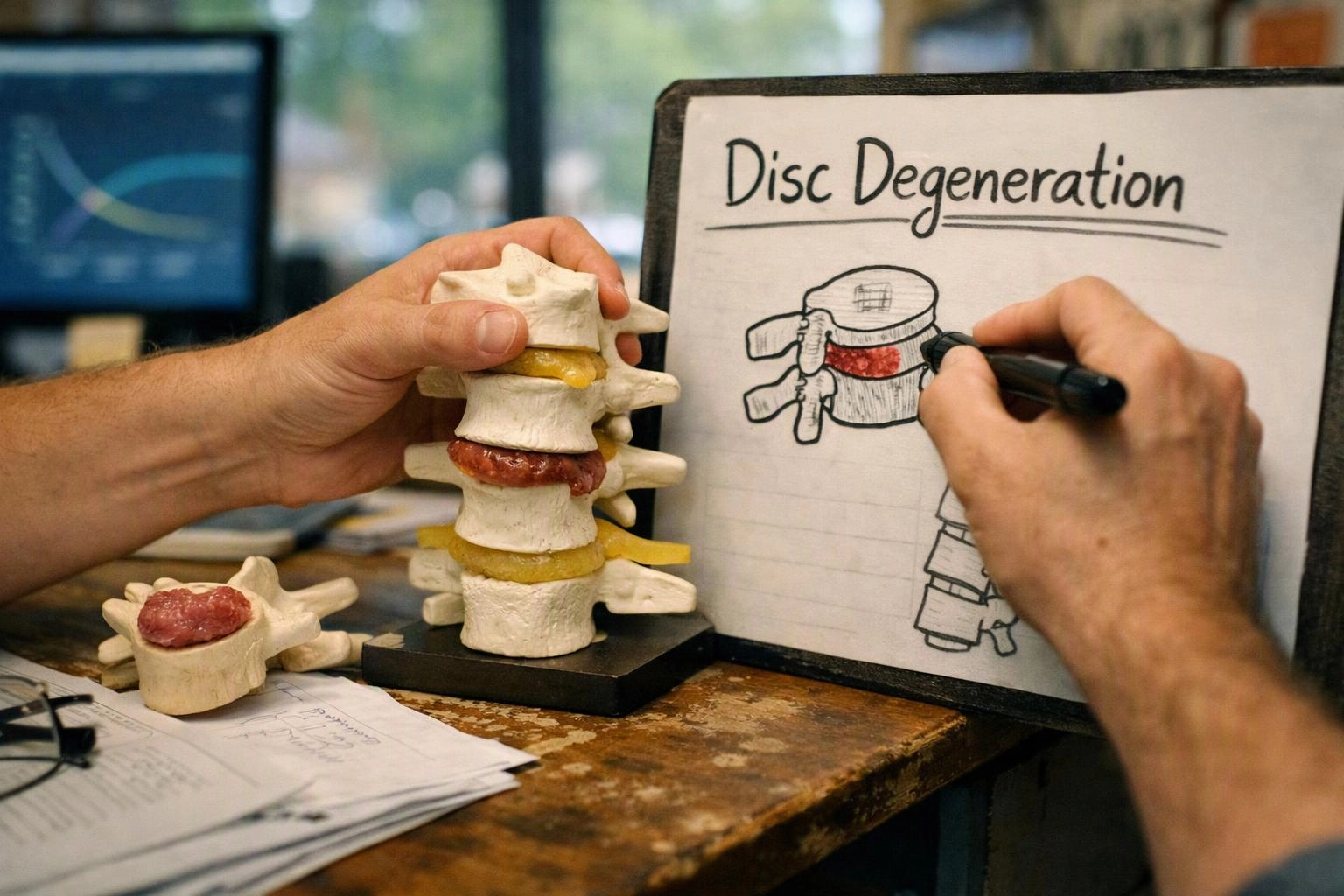
Disc degeneration describes changes in the structure and function of a spinal disc. Each disc sits between vertebrae and helps distribute movement and pressure. Over time, a disc may lose water content, become less flexible, or develop small surface changes. These processes can alter how the spine moves.
Related glossary terms: Bulging Disc, Disc Protrusion, Lumbar Spine.
Symptoms depend on the location and extent of the changes, along with the response of nearby joints, muscles, and nerves. A person may have disc degeneration without pain. A clinical assessment considers the symptom pattern, movement, strength, sensation, and findings from imaging when imaging is available. The term does not by itself identify the exact source of pain or prove that a disc is pressing on a nerve.
From the Arrowhead Clinic Chiropractic - Albany team
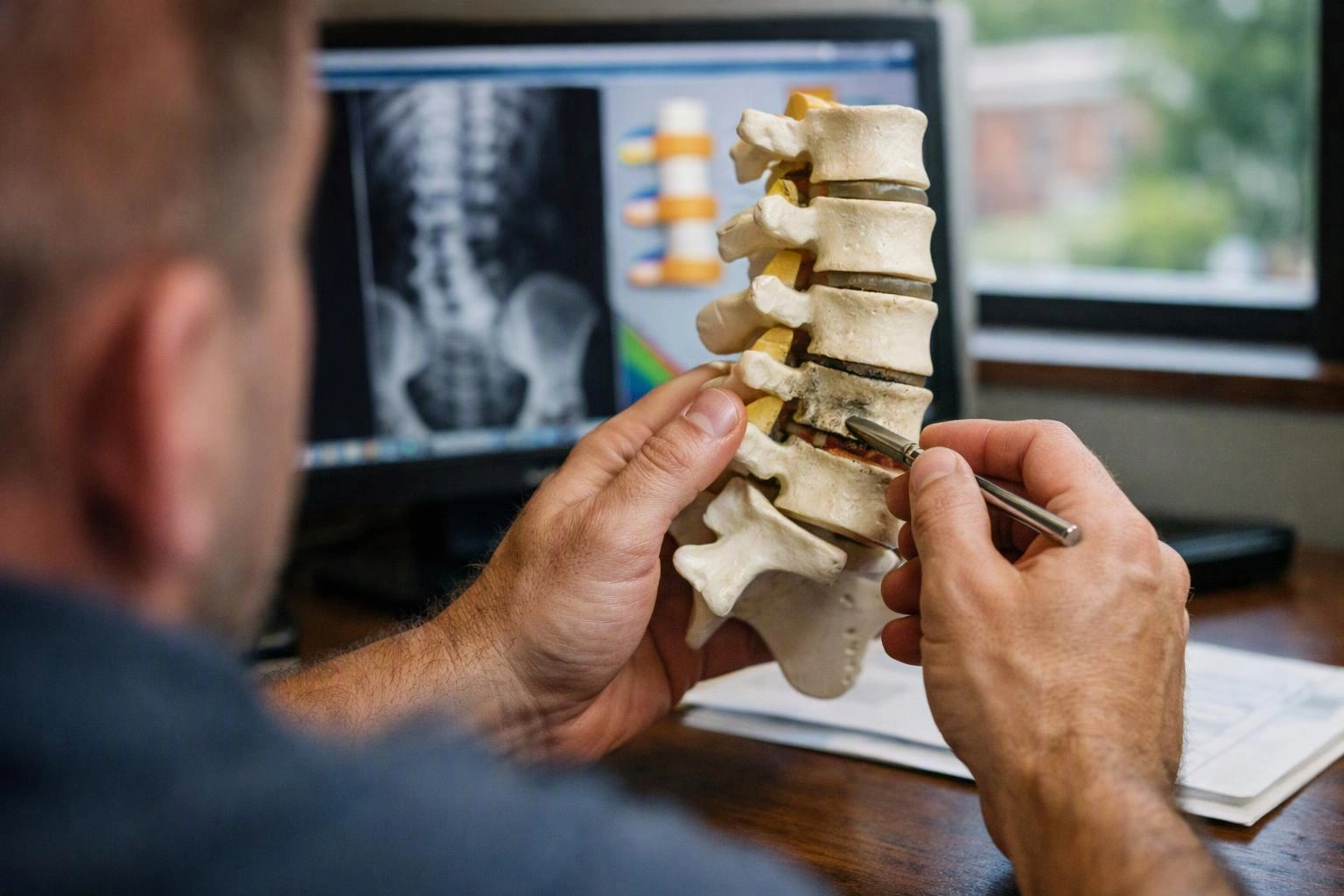
When we assess disc degeneration during Herniated Disc Treatment, we review the person’s symptoms alongside movement, strength, sensation, and functional limits. We distinguish disc changes from findings such as muscle guarding or nerve irritation. Our team uses that broader picture to guide appropriate chiropractic care and to identify concerns that may need medical evaluation.
Disc Degeneration in Practice: A Real-World Example
A person with lower back pain may have disc degeneration in the lumbar spine and feel stiffness after sitting. The same person may also have nerve irritation, so the examination must consider both disc findings and the pattern of symptoms.
Related Terms
Bulging Disc
A bulging disc is a spinal disc that extends beyond its usual boundary while the outer…
Disc Protrusion
A disc protrusion is a condition in which the outer portion of a spinal disc extends…
Lumbar Spine
A lumbar spine is the lower section of the spinal column between the thoracic spine and…
Nerve Root
A nerve root is a bundle of nerve fibers that leaves the spinal cord through an…
Arrowhead Clinic Chiropractic - Albany
Have Questions About Disc Degeneration?
Contact Arrowhead Clinic Chiropractic - Albany for practical guidance on Disc Degeneration and related chiropractor work in Albany.