
What Is a Muscle Spasm?
A muscle spasm is an involuntary, sudden tightening of muscle fibers that can create pain, stiffness, or restricted movement. The contraction may affect a small area, such as a lower-back muscle, or involve a broader muscle group. Spasms can occur after strain, prolonged posture, sudden movement, or irritation near the affected tissue.
Quick Facts About Muscle Spasm
Category
Muscle and movement condition
Used for
Describing sudden muscle tightening
Common confusion
Often confused with muscle strain
Also called
Muscle Cramp
Often discussed with
Back Pain Treatment, Manual Therapy
Key Takeaways About Muscle Spasm
- Spasms involve involuntary tightening, not simply general muscle soreness.
- Movement limits may reflect protective tension around an irritated area.
- A spasm is not the same as a muscle tear.
How Muscle Spasm Works

A muscle spasm begins when muscle fibers contract without conscious control and remain tense for a period of time. The area may feel firm, tender, or difficult to move. In the lower back, this response can limit bending or turning because surrounding muscles tighten during movement.
Related glossary terms: Sprain and Strain, Trigger Point, Range of Motion.
Assessment focuses on the location of the tension, the movements that change symptoms, and the condition of nearby joints and tissues. A clinician may also consider posture, recent activity, muscle strength, and range of motion. Muscle strain refers to damage or overstretching of muscle fibers, while a spasm describes the involuntary contraction that may accompany irritation.
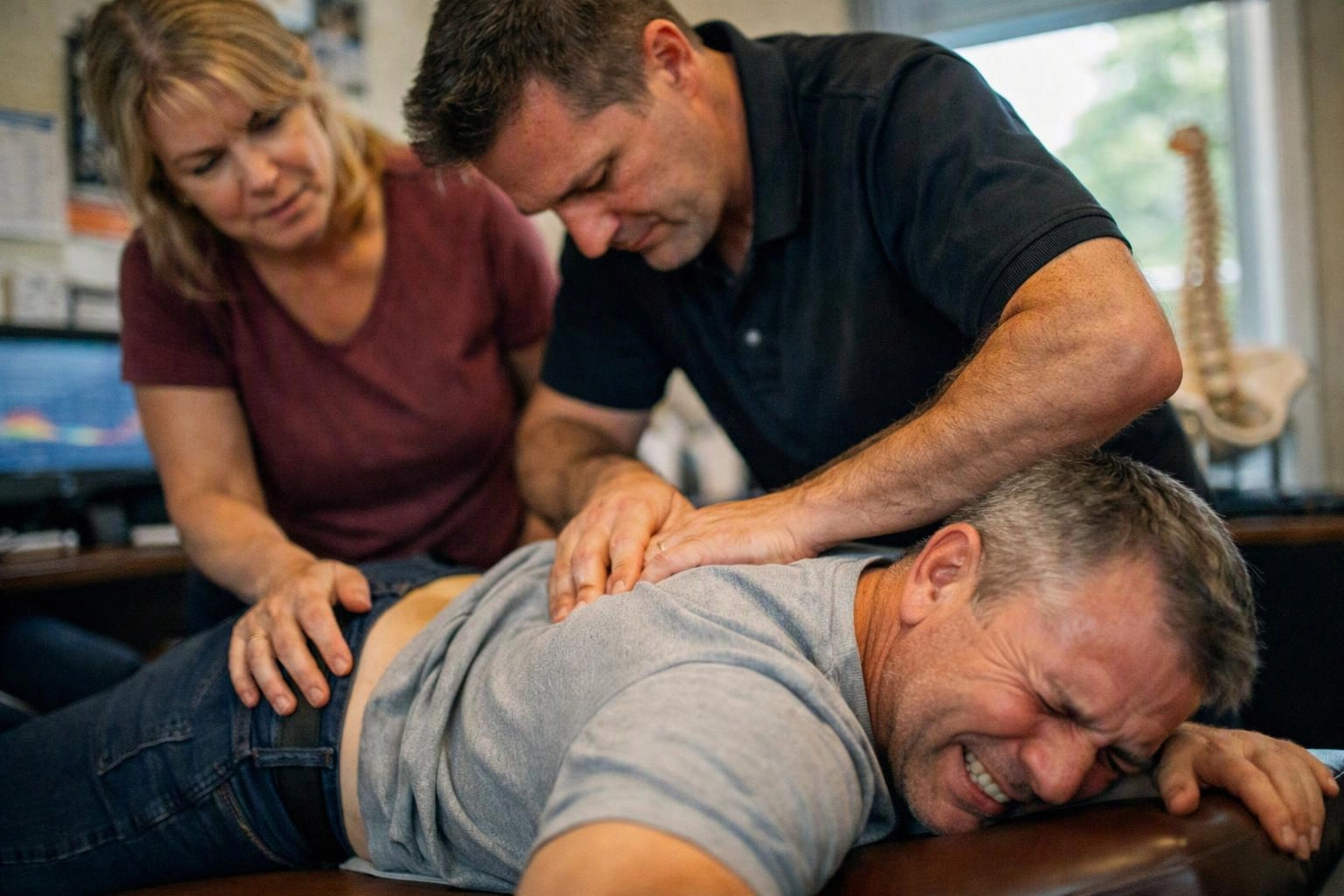
From the Arrowhead Clinic Chiropractic - Albany team
When we assess a muscle spasm, we examine the painful area alongside nearby joints, posture, and movement. We look for changes in muscle tension and range of motion, then relate those findings to the person’s back pain pattern. This approach helps us distinguish protective tightness from signs that call for broader evaluation.
Muscle Spasm in Practice: A Real-World Example
A person develops lower-back pain after lifting a heavy box and notices that the back tightens during bending. The muscle spasm may restrict movement while the surrounding tissues respond to strain or irritation.
Related Services
Related Terms
Sprain and Strain
A sprain and strain are soft-tissue injuries that affect different structures. A sprain involves a ligament…
Trigger Point
A trigger point is a tender, sensitive area within a muscle or its surrounding connective tissue…
Range of Motion
Range of Motion is the degree through which a joint can move in a specific direction…
Lumbar Spine
A lumbar spine is the lower section of the spinal column between the thoracic spine and…
Arrowhead Clinic Chiropractic - Albany
Have Questions About Muscle Spasm?
Contact Arrowhead Clinic Chiropractic - Albany for practical guidance on Muscle Spasm and related chiropractor work in Albany.