
What Is a Whiplash-Associated Disorder?
A Whiplash-Associated Disorder is a group of symptoms and functional changes that may follow a sudden neck movement, often during a vehicle collision. The condition can involve neck pain, stiffness, headaches, reduced motion, or related discomfort. Symptoms may appear soon after the event or develop as the body responds over time.
Quick Facts About Whiplash-Associated Disorder
Category
Post-collision neck condition
Used for
Describing symptoms after sudden neck movement
Common confusion
Not identical to a neck sprain
Also called
Whiplash Injury, WAD
Often discussed with
Auto Accident Injury Treatment, Whiplash Treatment
Key Takeaways About Whiplash-Associated Disorder
- The term covers symptoms, not one single tissue injury.
- Neck movement and symptom patterns help guide evaluation.
- Whiplash is not limited to visible damage on imaging.
How Whiplash-Associated Disorder Works

Whiplash-Associated Disorder describes how a sudden neck force may affect muscles, joints, nerves, and movement control. The term focuses on the person’s symptoms and function, so a visible injury is not required for the term to apply. Reported symptoms may include stiffness, tenderness, headaches, or discomfort that spreads toward the shoulders.
Related glossary terms: Cervical Spine, Range of Motion, Sprain and Strain.
Evaluation connects the event with symptom patterns and physical findings. A clinician may review how the collision occurred, check neck range of motion, and assess strength, sensation, and coordination. The findings help distinguish a broader whiplash-associated disorder from a more specific condition, such as a cervical spine fracture or a focused muscle spasm. The condition can change as symptoms settle, persist, or affect daily activities.
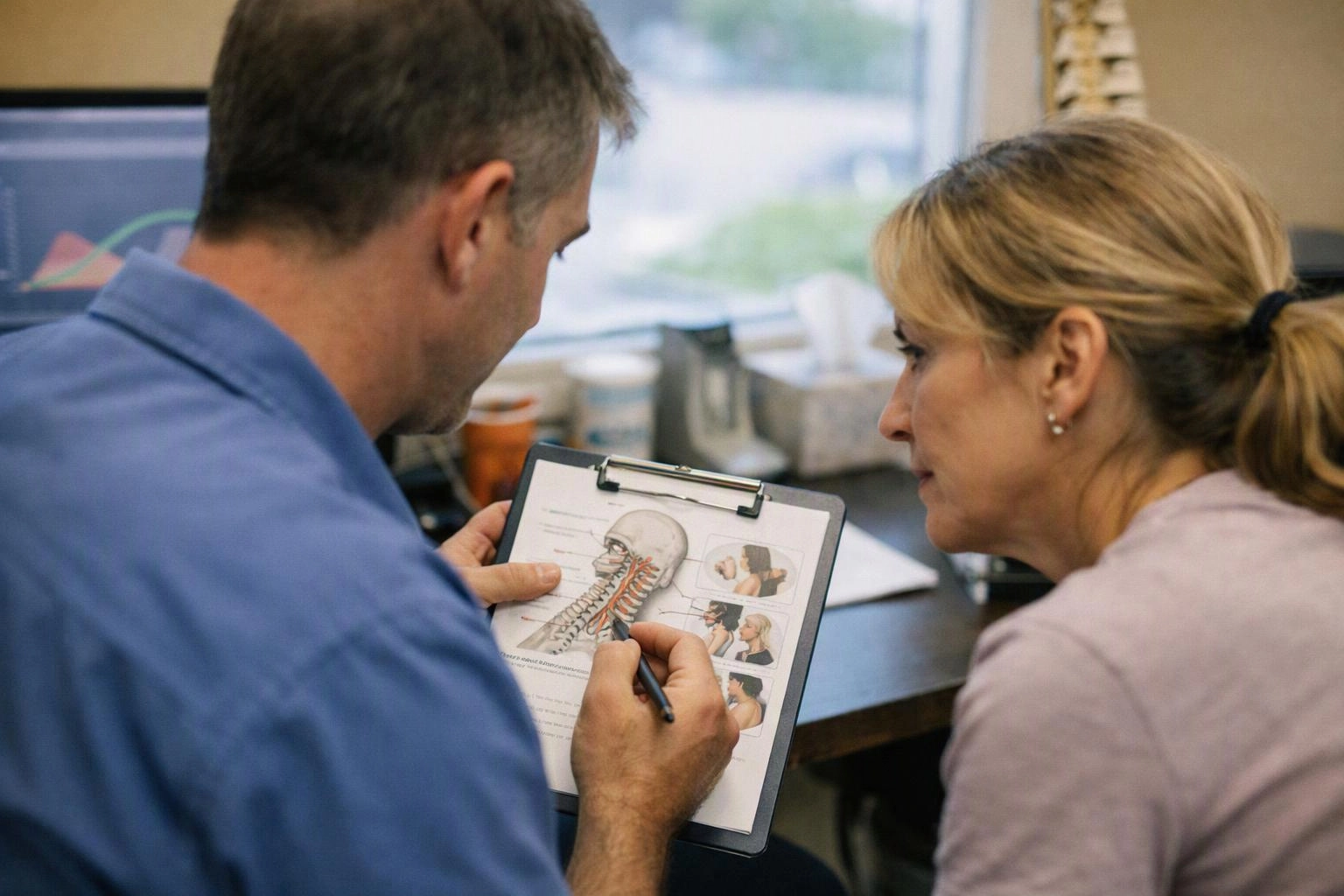
From the Arrowhead Clinic Chiropractic - Albany team
When we assess Whiplash-Associated Disorder, we review the collision history, reported symptoms, and changes in neck movement. Our team also considers related findings that may point to muscle, joint, or nerve involvement. We use those observations to shape care within Auto Accident Injury Treatment.
Whiplash-Associated Disorder in Practice: A Real-World Example
After a rear-end collision, a person may develop neck stiffness, headaches, and trouble turning the head during daily activities. An evaluation may document these symptoms as Whiplash-Associated Disorder while checking for more specific injuries.
Related Services
Related Terms
Cervical Spine
The cervical spine is the neck section of the spinal column. It connects the skull with…
Range of Motion
Range of Motion is the degree through which a joint can move in a specific direction…
Sprain and Strain
A sprain and strain are soft-tissue injuries that affect different structures. A sprain involves a ligament…
Muscle Spasm
A muscle spasm is an involuntary, sudden tightening of muscle fibers that can create pain, stiffness…
Arrowhead Clinic Chiropractic - Albany
Have Questions About Whiplash-Associated Disorder?
Contact Arrowhead Clinic Chiropractic - Albany for practical guidance on Whiplash-Associated Disorder and related chiropractor work in Albany.